

General News
Commercial Property Sales, Purchases & Leases
What We Handle
01
More Than Transferring Ownership
Buying or selling commercial property is rarely just about transferring ownership. The legal structure of the transaction, the condition of the title, existing occupational arrangements and future development plans can all influence the value and success of the investment. Understanding these issues before contracts are exchanged allows informed commercial decisions to be made.
02
Where Transactions Actually Go Wrong
Commercial property transactions rarely become difficult because of the purchase price. More often, unexpected issues arise during the legal investigation of the property. Restrictions on use, defective title, rights benefiting neighbouring land or unresolved enquiries can delay completion or create unexpected liabilities after purchase. We identify those issues as early as possible, explain their practical implications and work with the other parties to resolve them before they become expensive obstacles.
03
From Heads of Terms to Registration
We begin by reviewing the heads of terms and understanding your objectives for the purchase. We investigate the legal title, carry out the appropriate property searches and review planning, environmental and lease documentation where necessary. We raise enquiries with the seller's solicitors, report our findings in straightforward terms and explain any risks that require consideration. Once everything is agreed, we prepare for exchange, complete the purchase and deal with the post-completion registration requirements.
01
Preparation Sells Property Faster
Preparing thoroughly before marketing a commercial property can make the sale process considerably smoother. Buyers will expect detailed information about ownership, leases, planning matters and any ongoing obligations affecting the property. Having this information available early helps avoid unnecessary delays once a buyer has been found and demonstrates that the transaction is ready to progress.
02
Why Sales Stall
Many commercial property sales are delayed because legal documents are prepared after a buyer has already been secured. Missing title documents, unanswered enquiries or incomplete lease information can quickly slow negotiations. We work proactively from the outset, helping sellers prepare the legal documentation early so enquiries can be answered efficiently and the transaction continues to move towards completion.
03
Getting the Pack Ready Early
We review the property's title documentation, prepare the contract pack and gather the information buyers will require during their investigations. We respond to legal enquiries, negotiate amendments where appropriate and liaise with estate agents, lenders and the buyer's solicitors throughout the transaction. We guide the matter through exchange and completion before dealing with any remaining post-completion requirements.
01
Knowing What You're Buying Into
Before committing to a commercial property transaction, it is important to understand any legal issues that could affect ownership, occupation or future development. Due diligence involves investigating the property's legal status, reviewing supporting documentation and identifying risks that may influence your decision to proceed or renegotiate the terms of the transaction.
02
Problems Are Cheaper Before Exchange
Problems discovered after completion can be expensive and difficult to resolve. Restrictive covenants, rights of way, planning issues, environmental concerns or defective title may all affect how a property can be used or developed. Our role is to identify those issues before contracts are exchanged, explain what they mean in practice and help you decide how best to proceed.
03
Searches, Leases and Enquiries
We review the legal title, commission the appropriate searches and examine leases, planning documentation and any supporting legal documents relevant to the transaction. Where concerns arise, we raise additional enquiries with the seller's solicitors and explain the practical implications of the information received. Our reports focus on the issues most likely to affect your ownership, occupation or investment.
01
Beyond a Standard Purchase
Acquiring or disposing of development land often involves additional legal considerations beyond a standard property transaction. Planning issues, access rights, infrastructure obligations, option agreements and conditional contracts can all influence the value and viability of a proposed development. Careful investigation helps reduce uncertainty before significant investment is made.
02
What You Can't See From the Site
Development opportunities frequently depend upon matters that cannot be seen simply by inspecting the site. Legal rights affecting access, planning constraints or historic title issues may all influence whether a project proceeds as intended. We help clients identify those matters early, understand the risks involved and negotiate documentation that reflects the commercial objectives of the development.
03
Options, Conditions and Consents
We investigate title, review planning documentation and advise on any agreements affecting the proposed development. We negotiate option agreements, conditional contracts and associated documentation where required, liaise with planning consultants and other professional advisers and guide the transaction through to completion whilst keeping you informed throughout.
01
Buying an Income, Not Just a Building
Commercial property investments are often purchased to provide long-term income, future development opportunities or capital growth. Understanding the legal position of existing leases, tenant obligations and property management arrangements is an important part of assessing whether an investment meets your objectives. Careful legal investigation provides greater certainty before significant financial commitments are made.
02
The Leases Decide the Return
The value of an investment property depends on more than the building itself. Existing leases, tenant covenants, rent review provisions and repairing obligations may all affect future income and potential liabilities. We explain those issues in practical terms so you understand how they may influence the property's long-term performance rather than simply reporting on the legal documents.
03
Investigating the Income Stream
We investigate title, review occupational leases, examine rent arrangements and advise on matters affecting the property's income and management. We report on the legal issues identified during our investigations, negotiate any outstanding matters with the seller's solicitors and complete the acquisition once the transaction is ready to proceed.
01
Managing Property at Scale
Managing a portfolio of commercial properties often involves ongoing acquisitions, disposals, refinancing and lease management. Taking a coordinated approach to legal support can help maintain consistency across the portfolio whilst identifying issues before they affect future transactions or management decisions.
02
No Property Stands Alone
Individual property matters rarely exist in isolation. Decisions affecting one property can influence refinancing, future acquisitions or wider investment objectives. We take time to understand the broader portfolio, allowing us to provide advice that supports your longer-term commercial plans rather than focusing solely on the immediate transaction.
03
Coordinated Legal Support
We advise on acquisitions, disposals, refinancing, title issues and wider property management matters across your portfolio. We review documentation, coordinate transactions where multiple properties are involved and work with your surveyors, accountants and lenders to ensure legal issues are managed efficiently as your portfolio develops.
01
Questions That Don't Fit a Category
Not every commercial property matter fits neatly into a particular category. You may have questions about ownership, title, rights affecting your property or a proposed transaction that has not yet progressed very far. Early advice can often help clarify your position before important decisions are made.
02
Small Issues, Bigger Problems Later
Small property issues can become larger problems if they are overlooked. Seeking advice at an early stage can help identify legal risks, explain available options and avoid unnecessary delays later in the transaction. We focus on providing practical guidance that helps you understand the position before committing to your next step.
03
A Clear Position, Then a Plan
We begin by understanding your circumstances and reviewing any documentation you already have. We explain the legal position, identify any issues requiring further investigation and advise on the most appropriate way forward. Where further legal work is needed, we clearly explain the process, likely timescales and the next stages before any work begins.
01
Understanding Business Lease Agreements
A commercial lease is a legally binding agreement between a landlord and a business tenant, setting out the terms on which a property is rented for business use. It determines how much rent you pay, who covers repairs and service charges, how long you are committed for, and whether you can leave early. A renewal updates an expiring lease so it still works for you. The terms agreed at this stage shape your costs and flexibility for years — so they deserve proper scrutiny before anything is signed.
02
Can't I Just Do It Myself?
Agents do deals; we guard what comes after. A lease that looks fine on the headline rent can hide repairing obligations, service charge exposure, or renewal traps that cost far more over the term. We review leases quickly — typically within days, not weeks — and report back in straightforward terms with a clear list of what needs changing and why. You'll know our fee before we start, and you'll understand every risk before you commit. No surprises in the lease, and none on our invoice.
03
From Heads of Terms to Keys
For new leases, we review or draft the document, flag the clauses that carry real financial consequences, and negotiate amendments with the other side until the terms protect you properly. For renewals, we advise on your rights under the Landlord and Tenant Act 1954 — the law that gives many business tenants the right to renew — serve the required notices correctly, and negotiate the updated terms. We handle the whole process through to completion and keep you informed in everyday terms at each stage.
01
Passing Your Lease On
An assignment transfers your lease to a new tenant, who takes over the right to occupy the property for the rest of the term. Subletting is different: you stay on the lease and remain responsible to the landlord, but allow someone else to occupy part or all of the space. Both usually require the landlord's formal permission, granted through a document called a licence. Each route has different consequences for who carries the risk — and choosing the wrong one can prove expensive.
02
The Liability You Didn't Know You Kept
The trap most tenants miss: handing your lease to someone else doesn't always end your responsibility for it. Many outgoing tenants are required to guarantee the incoming tenant's performance — meaning if your replacement stops paying rent, the landlord can come back to you. We make sure you understand exactly what liability you keep before you sign anything, not after. And because we act for landlords and tenants alike, we know what the other side will push for and how to respond to it.
03
Making the Handover Watertight
We start with the lease itself, checking what it permits and what conditions the landlord can lawfully impose. We then prepare or review the assignment or subletting documents, negotiate the licence with the landlord's solicitors, and deal with any guarantee the landlord requires — making sure its scope is no wider than it has to be. Throughout, we keep all parties moving so the transaction completes on schedule, and we confirm your remaining obligations in writing so nothing is left unclear.
01
Exiting Early, Changing Terms
A break clause gives the landlord, the tenant, or both the right to end the lease early on a fixed date, provided strict conditions are met. A lease variation is a formal change to the terms of an existing lease — adjusting the rent, the permitted use, or the repair obligations, for example. Both sound simple but operate on precise legal requirements. A break notice served a day late, or to the wrong address, can be completely invalid — locking you in for years longer than you planned.
02
Why Break Notices Fail
Break clauses are where tenants lose the most for the smallest mistakes. Courts have refused breaks because rent was a few pounds short, or a condition was overlooked — even where the tenant's intention was obvious. We treat break dates as hard deadlines: we diarise them, check every condition in advance, and serve notices in the precise form the lease demands. For variations, we put the change in writing properly, so neither side can dispute later what was actually agreed.
03
Getting It Right, On Time
Well before your break date, we examine the lease and identify every condition that must be satisfied — vacant possession, rent paid up, repairs completed — and tell you plainly what needs doing and by when. We then prepare and serve the break notice correctly and confirm the lease has validly ended. For variations, we draft the deed recording the new terms, make sure it is signed and completed properly, and register it where required, leaving a clear paper trail for both sides.
01
Ending a Lease by Agreement
A surrender brings a lease to an end early by mutual agreement between landlord and tenant. Unlike a break clause — a right written into the lease that one party can exercise alone — a surrender only happens if both sides agree terms. It is often the practical answer when a tenant needs out and the landlord is willing, perhaps in return for a payment or because they have a new tenant lined up. Done properly, both parties walk away with a clean, final ending.
02
More Than Handing Back the Keys
An informal surrender — handing back the keys and shaking hands — is one of the most common sources of later disputes. Without a proper deed, arguments surface months on about unpaid rent, repair costs, or whether the lease ever actually ended. We make the ending genuinely final: every outstanding liability identified, negotiated, and settled within the deal, then recorded in a single binding document. We work to your timetable, and we agree our fee with you before the work begins.
03
Negotiating a Clean Exit
First we establish what each side wants from the exit and whether any payment should change hands — a premium from the tenant, or a reverse payment from a landlord keen to regain the space. We then negotiate how rent arrears, repair liabilities, and dilapidations are dealt with, draft the deed of surrender capturing the full agreement, and see it signed and completed correctly. Where the lease is registered, we handle the Land Registry formalities so the records reflect the position.
01
End-of-Lease Claims Explained
Dilapidations are the repairs and reinstatement a tenant must carry out when a lease ends, returning the property to the condition the lease requires. Where that hasn't happened, the landlord may claim the cost of putting it right — often a substantial sum. Forfeiture is the other major flashpoint: a landlord's right to end the lease early because the tenant has broken its terms, most commonly by not paying rent. Both can escalate quickly, and both reward early, well-judged action.
02
We Know Both Playbooks
We act for landlords and tenants in equal measure, so we know both playbooks. Tenants facing a dilapidations claim are often quoted figures well beyond what the law actually allows the landlord to recover — we know where those limits lie and how to use them. Landlords pursuing forfeiture face strict procedural rules; one wrong step, such as accepting rent after a breach, can destroy the right to forfeit entirely. Either way, you get a realistic assessment first — not a fight for its own sake.
03
From Claim to Resolution
In dilapidations matters, we review the lease and any schedule of condition, work with surveyors to test what is genuinely claimable, and negotiate a settlement — or defend or pursue proceedings where negotiation fails. In forfeiture cases, we advise landlords on the correct route, prepare the necessary notices, and conduct possession proceedings through court; for tenants, we advise on relief from forfeiture, which can allow the lease to be saved. At every stage you'll know your options, the costs, and the realistic outcomes.
01
What Are You Actually Taking On?
Before committing to a commercial property, you need to know exactly what you are taking on. Due diligence is that investigation: checking the legal title, running property searches, and uncovering any rights, restrictions, or obligations attached to the property. Title and Land Registry checks confirm who actually owns it and whether anything is registered against it — mortgages, covenants restricting use, or rights of way. These checks regularly uncover issues that would change a deal, or change its price, if discovered in time.
02
Find Problems Before They Find You
Most deals fall apart late because something turned up that should have been found early. We front-load the investigation, ordering searches at the start rather than waiting for the transaction to mature, so problems surface while you can still negotiate around them — or walk away cheaply. Our reports don't bury the findings in legal language: you get a short summary of what matters, what it means for your plans, and what we recommend, so you can make the decision quickly and with confidence.
03
Searches, Checks and Clear Answers
We examine the registered title and supporting documents, identifying anything that could restrict your use of the property or impose costs — covenants, easements, charges, or gaps in the title. We order the searches the transaction genuinely needs, including local authority, drainage, and environmental searches, and chase the results so they don't hold things up. We then report our findings in everyday terms, raise enquiries with the other side where answers are needed, and negotiate solutions to any problems before you are committed.
01
Not Sure Where to Start?
Not every lease question fits a neat category. Perhaps a clause in your existing lease doesn't make sense, your landlord has demanded something you're unsure they can insist on, or you want a second opinion before signing. General lease advice is the open door for all of it — a straightforward way to get an expert view on any commercial lease issue, without needing to diagnose the problem yourself first. You bring the question; working out where it fits is our job, not yours.
02
Why Small Questions Matter
Small lease questions have a habit of becoming expensive ones when left alone — a misread service charge clause, a missed rent review deadline, a repair demand accepted that should have been challenged. We make early advice easy to get: a quick conversation to understand your situation, a clear view on where you stand, and a fixed cost agreed before any work begins. Many questions are resolved in a single session. When something bigger emerges, you'll hear it from us straight, with options.
03
A Straight Answer, Then a Plan
We start by listening, then give you a plain answer: what your lease actually says, what your rights and obligations are, and what we'd do in your position. That might be the end of it — or it might lead to a lease review, a letter to your landlord or tenant, or representation in a dispute. Whatever the next step, we scope it clearly, confirm the cost, and agree it with you first. Nothing proceeds without your say-so, and nothing arrives unexplained.

"Commercial property transactions involve significant legal and financial commitments. Whether you're buying, selling, leasing or developing property, we help you understand the legal issues, manage risk and keep your transaction moving forward."~ Robert Boon

Robert Boon
Director

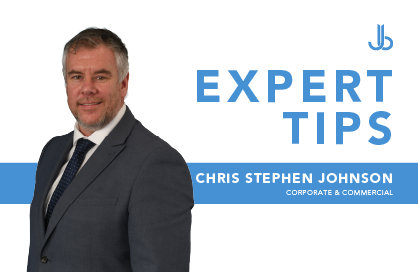
Christopher Stephen Johnson
Head of Corporate & Commercial

Adam Chiocchi
Solicitor

Mark Johnson
Commercial Paralegal

Janice Johnson
Practice Manager

Heather Boon
Legal Assistant

Roisin Ryder
Legal Assistant
Frequently Asked
Questions
Do I need a solicitor before agreeing heads of terms?
Although heads of terms are often prepared before solicitors become involved, obtaining legal advice early can help identify potential issues before significant negotiations take place.
How long does a commercial property transaction take?
Timescales vary depending on the complexity of the property, the parties involved and whether additional investigations are required. We will explain the likely timetable once we understand the transaction.
What searches will be carried out?
The searches required depend upon the property and the nature of the transaction. We will advise which investigations are appropriate and explain why they are recommended.
What happens if legal issues are discovered during the transaction?
We will explain the issue, discuss the options available and advise how it may affect the transaction before you decide how to proceed.
Do you act for investors as well as owner-occupiers?
Yes. We advise investors, developers, landlords and businesses buying premises for their own use. The legal issues overlap, but the priorities differ, and we approach each accordingly.
How much will it cost?
We will explain the likely cost once we understand what is involved. Where a fixed fee is available, we will confirm what is included before work begins.





Contact Johnson & Boon
Call us
0151 6372 034